
Written by Olivia Burlew

Credit: Autism_Sketches
Image found on Instagram
Autism Spectrum Disorder (ASD) is a neurodevelopmental condition that affects how individuals interact with others, communicate, learn, and behave. It is characterized by persistent challenges in social interactions and communication, as well as restricted interests and repetitive behaviors. ASD is referred to as a spectrum because it presents differently in each person, with a wide range of strengths and challenges and no single typical pattern.
During infancy, a huge burst of synapse formation occurs especially in the cortex, which is responsible for language, memory, reasoning, thought, learning, decision-making, emotion, intelligence, personality, attention, perception, awareness, consciousness, motor-function and movement, planning, processing sensory information, and problem-solving. Synaptic overgrowth happens from birth until about 2 years, at which time synaptic pruning begins to optimize the neurological networks by removing redundant connections making the brain more efficient. By adulthood, autistic individuals have about 41% fewer neurons than newborns. In allistic individuals the neuron density only drops by about 16% leading to overconnectivity.
So, suddenly that tag in the back of your shirt that the allistic brain can find a way to ignore cannot be ignored by the autistic brain makes sense. The sound the refrigerator in the break room is making that everyone else can tune out? The autistic brain may not be able to hear you over that noise. Now imagine the tag of the shirt, the refrigerator noise, and someone placing demands on the Autistic individual. This is sensory overload which can lead to dysregulation in an Autistic individual.
Stereotypes Associated with ASD
When people hear the word ‘Autistic,’ one of the first characters most often thought of is Raymond Babbitt from the movie Rain Man. For some this may be the only exposure to an autistic individual they’ve ever had. These portrayals of Autism are often problematic as they can lead to negative stereotypes applied to all Autistics.
- Autistic people are aggressive: Overstimulation can lead to outbursts, but this can happen in any population. Often the appearance of aggression is just sensory overload or dysregulation.
- Autistic people have obsessive interests: Intense interests are common but not unique to Autistic individuals. Some hyper fixations are considered acceptable while others aren’t.
- Autistic people are geniuses or unintelligent: Intelligence varies widely among Autistic individuals.
- Autistic people can’t communicate: Challenges could exist, but many Autistic individuals use alternative communication methods.
- Autistic people don’t look different: Autism is considered an invisible disability; it doesn’t affect physical appearance unless it has a comorbidity with another genetic condition.
- Autistic people don’t have emotions: Autistic individuals feel emotions like everyone else. How they express those emotions, however, may differ. Some individuals are hyper empathetic, and some have learned to mimic behaviors.
- Autistic people can’t have meaningful relationships: Communication and social cues can make relationships challenging, but supportive partnerships are possible.
- Autistic people aren’t employed: Autistic individuals have the highest unemployment rates in the disability community due to discrimination and lack of workplace accommodations.
Way You Can Support Your Autistic Co-worker or Employee
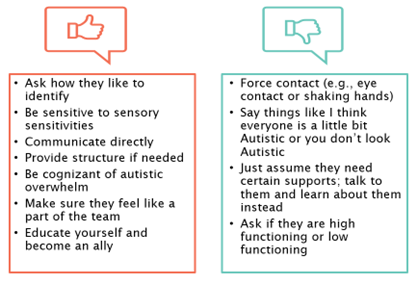
Here are a few do’s and don’ts you can use to help show support for your Autistic co-worker. Firstly, it’s important to use respectful and inclusive practices. Identity-first language (e.g., “I am Autistic”) is often preferred, though some may favor person-first language (e.g., I have Autism), so it’s best to ask. Take time to understand their needs by asking which environments are most challenging—such as lighting, sounds, or smells—and what strategies help when they feel overwhelmed or anxious. Learn their preferred communication style, whether it’s written, visual, or verbal, and avoid vague language or innuendos. Instead of making assumptions, ask what support they may need to succeed—such as agendas before meetings or clear, specific instructions. Never exclude someone because you’re unsure how to engage; educate yourself and approach interactions with empathy. Understand that behaviors like avoiding eye contact or declining handshakes are not signs of rudeness. Also, avoid minimizing the Autistic experience with seemingly kind but dismissive remarks. Treat Autistic employees like any other valued team member you’re getting to know. A good leader/co-worker adapts without waiting for a formal accommodation request. For additional resources on Autism, visit Autistic Self-Advocacy Network.
Changing the Narrative from Awareness to Acceptance
Awareness is about recognizing that something uncommon exists, often highlighting differences between “us” and “them” without necessarily promoting understanding or inclusion. In contrast, acceptance focuses on embracing individuals by emphasizing our shared humanity and the strength found in diversity. It’s about creating a sense of belonging, showing empathy, and making thoughtful adjustments to help individuals feel comfortable and supported.